Friday, November 14, 2014

St. Gregory Palamas

Born at Constantinople in 1296, St. Gregory Palamas was a monk of Mount Athos in Greece and later the Archbishop of Thessaloniki known as a preeminent theologian of Hesychasm. The teachings embodied in his writings defending Hesychasm against the attack of Barlaam are sometimes referred to as Palamism, his followers as Palamites. 
Some of his writings are collected in the Philokalia. The second Sunday of the Great Lent is called the Sunday of Gregory Palamas.

St. Gregory taught us that unceasing mental prayer is the duty of ALL Christians and the prayer known as the "Jesus Prayer" is often used for this purpose in the Orthodox Tradition.
O Lord Jesus Christ, Son of God, have mercy on me a sinner.

In fact, here is a craft in honor of  St. Gregory Palamas. Make a paper prayer rope! Simply cut out the words of the JESUS PRAYER and glue each word onto a paper "bead." Glue them in a circle shape. If you want, print out an icon photo of St. Gregory Palamas and glue it in the middle! You can add a cross at the bottom too (shown below).
O light of Orthodoxy, teacher of the Church, its confirmation,
O ideal of monks and invincible champion of theologians,
O wonder-working Gregory, glory of Thessaloniki and preacher of grace,
always intercede before the Lord that our souls may be saved.

Tuesday, November 11, 2014

St. Martin of Tours

St. Martin of Tours (Latin: Martinus), was a bishop of Tours in the 4th century. Martin was born in 316 or 317 in Sabaria, Pannonia, in present day Hungary, into a military family. He showed interest in Christianity at an early age. He was named after the Roman god Mars. Against his parents' wishes, young Martin began attending church at the age of ten, becoming a catechumen. At the age of 15,  being the son of a Roman officer, he was required to join the cavalry. In the course of his duties in 334 he was stationed at Samarobriva, Gaul, (modern day Amiens, France). After service as a soldier in the Roman army, he was baptized and became a disciple of St. Hilary of Poitiers, who was prominent in the trinitarian disputes with the Arians. He was acclaimed bishop of Tours in 371. He founded the monastery Marmoutier where he led a austere life with cave-dwelling cenobites. Veneration of Martin was very popular in western Europe during the middle ages.
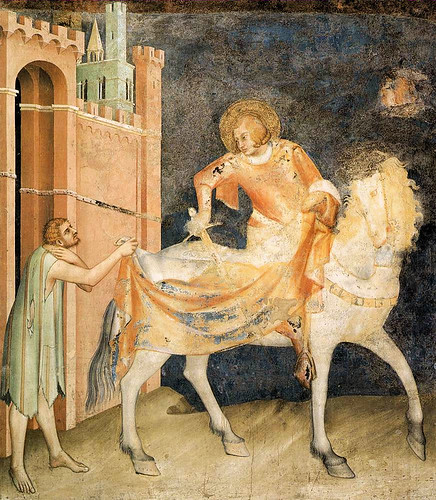
File:Saint Martin of Tours and the episode of the cloak.jpg
It was while in Amiens that he experienced a vision that became a memorialized event in his life. He had met at the gates of the city of Amiens a scantily dressed beggar for whom Martin cut in half his military cloak to share it with the beggar. That night, he dreamed of Jesus wearing the half cloak that Martin had given away and heard Jesus telling the angels: "Here is Martin, the Roman soldier who was not baptized. He has clad me." Confirmed in his intent by this vision, Martin was baptized and after serving two more years left the army. He then traveled to Tours.

In 371, Martin was acclaimed bishop of Tours. As bishop of Tours he greatly impressed the city's inhabitants with his demeanor and zeal in destroying the pagan temples. Sulpicius Severus recorded in the Vita of St. Martin many of the events of this period. Sulpicius further recorded Martin's withdrawal from the tensions of the city to the monastery, Marmoutier, that he founded across the Loire river from Tours. Here Martin led a austere life among the cave-dwelling cenobites who had gathered around him.
After his death he was buried in Tours where, in time, a large basilica was built as the shrine of St. Martin of Tours. The basilica was built over his grave and was a major stopping point on pilgrimages during the middle ages. During the Wars of Religion in 1562, the Huguenots sacked the shrine and it was completely destroyed during the French Revolution. Two streets were built over the site to ensure it could not be re-built.

St. Martin of Tours continues to be remembered in many parts of western Europe through annual processions and the giving of presents to children on his day, November 11, instead of December 6 (St. Nicholas of Myra) or December 25 (Nativity). 

Read together "The Life of Martin of Tours" by St. Sulpitius Severus
"THE LIFE OF SAINT MARTIN" written by Verena Smith and illustrated by Emile Probst

Martinmas is widely celebrated in Western Europe. In honor of St. Martin, here are a few activities to do as a family:
Martinmas lanterns to celebrate St. Martin's warm spirit of giving and kindness towards those in need (especially beggars and the homeless)

If you have older kids, you can consider making real lanterns out of mason jars (saved for the 11th hour on 11/11 - a German tradition) :
 
Gather coats and jackets to donate to a charity in honor of St. Martin's gift of half of his cloak to a beggar. 

There are some really cute cookie molds in the shape of St. Martin if you are in a baking mood!

Color a picture of St. Martin of Tours
In signs and in miracles you were renowned throughout Gaul. / By grace and adoption you are a light for the world, O Martin, blessed of God. / Almsdeeds and compassion filled your life with their splendors, / Teaching and wise counsel were your riches and treasures, / Which you dispense freely to those who honor you.

Sunday, November 9, 2014

St. Nectarios the Wonderworker of Aegina

St. Nectarios of Aegina (1846–1920) Metropolitan of Pentapolis and Wonderworker of Aegina, was officially recognized as a Saint by the Ecumenical Patriarchate of Constantinople in 1961. His Feast Day is celebrated every year on 9 November.

Anastasios Kephalas, later Nectarios, was born on 1 October 1846 in Selymbria in Thrace to a poor family. His parents, Dimos and Maria Kephalas, were pious Christians but not wealthy.
At the age of 14, he moved to Constantinople (Istanbul) to work and further his education. In 1866, at age 20, he moved to the island of Chios to take a teaching post. On November 7, 1876, he became a monk, at age 30, in the Monastery of Nea Moni, for he had long wished to embrace the ascetic life.
Three years after becoming a monk he was ordained a Deacon, taking the name Nectarios. He graduated from the University of Athens in 1885. During his years as a student of the University of Athens he wrote many books, pamphlets, and Bible commentaries.
Following his graduation he went to Alexandria, Egypt, where he was ordained a priest and served the Church of Saint Nicholas in Cairo. He was consecrated Metropolitan bishop of Pentapolis (an ancient diocese in Cyrenaica, in what is now Libya) by the Greek Orthodox Patriarch Sophronios in 1889.
He served as a Bishop in Cairo for one year, but was removed from his post and sent away from Egypt without explanation. He then returned to Greece in 1891, and spent several years as a preacher (1891–1894). He was then director of the Rizarios Ecclesiastical School for the education of priests in Athens for 15 years. He developed many courses of study, and wrote numerous books, while preaching widely throughout Athens.
In 1904, at the request of several nuns, he established Holy Trinity Monastery for them on the island of Aegina.
St. Nectarios died on November 8, 1920, at the age of 74, following hospitalization for prostate cancer and two months of treatment. His body was taken to the Holy Trinity Convent, where he was buried by his best friend St. Savvas of Kalymnos, who wrote the first icon of St. Nectarios. The funeral of St. Nectarios was attended by multitudes of people from all parts of Greece and Egypt.

To learn more about the life of St. Nectarios, read:

"The Story of the Holy Hierarch Nectarios the Wonderworker" written by Catalin Gregore, illustrated by Cristina Ionescu-Berechet
"Saint Nectarios' Shoes" by Egle-Ekaterine Potamitis

 
A tribute to St. Nectarios

Saturday, October 25, 2014

St. Tabitha the Widow


In Joppa (Israel) there was a certain disciple named Tabitha the widow, which is translated as Dorcas. This woman was full of good works and charitable deed.. But it happened in those days that she became very ill and died.
At the time, the Apostle St.  Peter was preaching at Lydda, not far from Joppa. Messengers were sent
to him with an urgent request for help. When the Apostle arrived at Joppa, Tabitha was already dead. On bended knee, St Peter made a fervent prayer to the Lord. Then he went to the bed and called out, “Tabitha, get up!” She arose, completely healed (Acts 9:36). Tabitha was raised from the dead by the Apostle St. Peter!

St. Tabitha is considered the patron saint of tailors and seamstresses, since she was known for sewing coats and other garments (Acts 9:36-42).

St. Tabitha is the patron saint of seamstresses & tailors, and spend a great deal of her life sewing and repairing garments - probably for those less fortunate citizens. In her honor, do a threading craft with your child in the shape of a coat or garment.

First, print out a coat or jacket (below)

Decorate it with your child.

Then, with a hole punch (or scissors if you don't have one) make a few holes around the perimeter of the coat.

With the yard of your choice, knot one end on the back of the paper and have your child thread ("sew") the coat by weaving in and out of the holes like St. Tabitha did.

Or just color a picture of a seamstress and discuss how important they were in society when resources were scarce.


Saturday, October 18, 2014

St. Luke the Prophet and Evangelist

St. Luke, who is credited with recording the life of Christ through his Gospel of the New Testament, was also known as the "glorious physician," and for his artistic ability. St. Luke was born in Antioch, Syria, where he began to commit his life to Christ upon meeting St. Paul. Prior to this time, Luke was a well-known physician of his time, praised with his skill in healing the afflicted. However, around 50 AD, Luke left his calling behind and joined St. Paul so that together they could glorify Christ.
As a missionary orator, St. Luke was not as skilled as St. Paul. However, his talent in writing and artistry far surpassed the skill of many during that time. St. Luke is highly acclaimed for his contributions to The New Testament. The Book of Acts and the Gospel according to St. Luke are detailed in history, expression, and narration that is often thought to outshine other Christian literary works. His mastery of the Greek language allowed him to express his thoughts about Christ with such passion, much of which is lost in translation.
Moreover, St. Luke is recognized as one of the first iconographers of Christianity. He used his talent in art to depict the Virgin Mary holding the Christ-child. Upon seeing the icon, the Theotokos gave
St. Luke her blessing to continue with the depiction, which he later completed and presented to the Mother of God as a gift. Currently, this icon resides at the Mega Spileion monastery in Greece. Participants of Ionian Village visit this monastery to learn about St. Luke’s contribution to iconography, as well as of the icon’s discovery after being hidden in a cave and guarded by a beast for so long.

Saint Luke the Evangelist is the patron saint of artists, physicians, surgeons, and students.  

The holy relics of St. Luke the Apostle are so divided:
Read the miraculous story of "The Hermit, The Icon & The Emperor: The Holy Virgin Comes to Cyprus" by Chrissi Hart.

Color (or paint!) a picture of the most Holy Theotokos with your child and describe the importance of icon writing in our church life.

Monday, October 6, 2014

St. Kendeas of Cyprus

St. Kendeas was a monk who lived between the 7th and 10th centuries and is recognized as a saint by the Orthodox Church. His cave, church, and monastery are located near the village of Avgorou, in a fertile region of Cyprus that is famous for growing potatoes and for basket-weaving. Nearby coastal towns are known for their sandy beaches and clear turquoise water.
Saint Kendeas left his homeland of Alemanni (modern Germany) when he was 18 and went to Jerusalem to live a monastic life with other hermits in the desert of Jordan. There he healed a young boy who was the son of a great nobleman from Jerusalem. From Jordan he traveled by boat with other hermit monks to Cyprus, where, upon arrival, they miraculously survived a shipwreck. Eventually, Saint Kendeas went to live alone in a cave near Avgorou, spending the rest of his life as an ascetic. When Saint Kendeas arrived at the cave, he was thirsty and prayed to God for water to drink. The Stone he knelt on filled with clear holy water, which still flows today.
Throughout the centuries many sick people have asked Saint Kendeas for his help. Through his prayers to God, they have been cured. He lived a long and virtuous life and has continued to perform numerous wonders and miracles for children and adults who believe in him and love Jesus Christ. His feast day is celebrated on October 6.

Read "Under The Grapevine: A Miracle By St. Kendeas of Cyprus" by Chrissi Hart.

For a craft, color a cave and paste small rocks on it to represent the rocks that provided water as a mircale.
 
Troparion to Saint Kendeas
Having hallowed through struggles the Jordan wilderness and the island of Cyprus,
You shone out upon all through remarkable battles as a fixed star.
Therefore, having seen the fullness of your wonders,
O God-bearing Kendeas, we lift our voices:
Glory to You, O Christ, through him who extols.
Glory to You through him who magnifies.
Glory to the One who through you heals illnesses for all.

Wednesday, October 1, 2014

St. Romanos the Melodist


St. Romanos the Melodist (or Hymnographer) was one of the greatest of Greek hymnographers in the Orthodox church. He was called "the Pindar of rhythmic poetry." St. Romanos flourished during the sixth century, which is considered to be the "Golden Age" of Byzantine hymnography.

St.Romanos was born in the fifth century in the Syrian city of Emesa of Jewish parents. After moving to Constantinople, he became a church sacristan in the temple of Hagia Sophia. The monk spent his nights alone at prayer in a field or in the Blachernae church beyond the city.

St Romanus was not a talented reader or singer. Once, on the eve of the Nativity of Christ, he read the kathisma verses. He read so poorly that another reader had to take his place. The clergy ridiculed Romanus, which devastated him.
On the day of the Nativity, the Mother of God appeared to the grief-stricken youth in a vision while he was praying before her Kyriotissa icon. She gave him a scroll and commanded him to eat it. Thus was he given the gift of understanding, composition, and hymnography.
That evening at the all-night Vigil St. Romanos sang, in a wondrous voice, his first Kontakion: “Today the Virgin gives birth to the Transcendent One...” All the hymns of St. Romanos
became known as kontakia, in reference to the Virgin’s scroll. St. Romanos
was also the first to write in the form of the Oikos, which he incorporated into the all-night Vigil at his places of residence.
For his zealous service, St.Romanos was ordained as a deacon and became a teacher of song. Until his death, which occurred about the year 556, the hierodeacon Romanos
the Melodist composed nearly 1,000 hymns, many of which are still used by Christians to glorify the Lord. Only about eighty survived.

To celebrate his feast day, read "Sweet Song: A Story of Saint Romanos the Melodist" by Jane G. Meyer

Here are a few "visuals" to help your child appreciate the beauty of St. Romanos the Hymnographer's music:

https://www.youtube.com/watch?v=W33yzY1u2KQ  

This music sheet candle is one way to celebrate the feast day of our greatest musical saint! Would be a fun craft for kids both young and old!

Troparion (Tone 4)
You gladdened Christ's Church by your melodies
like an inspired heavenly trumpet.
You were enlightened by the Mother of God
and shone on the world as God's poet.
We lovingly honor you, righteous Roman.