Thursday, April 23, 2015

St. George the Trophy-Bearer

The holy, glorious and right-victorious Great-martyr and Trophy-bearer St. George was a Christian Roman soldier killed under Diocletian at the beginning of the 4th century.
According to Tradition, George was born to a Christian family during the late 3rd century. His father was from Cappadocia and served as an officer of the army. His mother was from Lydda, Palestine. She returned to her native city as a widow along with her young son after the martyrdom of George's father, where she provided him with a respectable education and raised him in piety.
The youth, it would seem, followed his father's example in joining the army soon after his coming of age. He proved to be a charismatic soldier and consequently rose quickly through the military ranks of the time. By his late 20s he had gained the titles of tribunus (tribune) and later comes (count). By that time George had been stationed in Nicomedia as a member of the personal guard attached to Roman Emperor Diocletian (reign 284–305).
In 303, Diocletian issued an edict authorizing the systematic persecution of Christians across the Roman Empire. His Caesar, Galerius, was supposedly responsible for this decision and would continue the persecution during his own reign (305–311). It is believed that St. George was ordered to take part in the persecution, but instead confessed to being a Christian himself and criticized the imperial decision. An enraged Diocletian proceeded in ordering the torture of this apparent traitor and his execution.
Then, after innumerable forms of torture, George was executed by decapitation in front of Nicomedia's defensive wall on April 23, 303. The witness of his suffering convinced Empress Alexandra and Athanasius, a pagan priest, to also become Christians, and so they also joined St. George in martyrdom as consequence. St. George's body was then returned to Lydda for burial, where Christians soon came to honor St. George as a martyr.

St. George and the dragon
St. George is often depicted with a dragon or some other serpentine creature under his feet. This comes from a legend whose details may vary according to local tradition. The tale begins with a dragon making its nest at the spring (or lake) that provided a town (either near Beirut or Silena, Libya) with water. Consequently, the citizens had to temporarily remove the dragon from its nest in order to collect water. To do so, they offered the dragon a daily human sacrifice. The victim of the day was chosen by drawing lots. Eventually, the "winner" of this lottery happened to be the local princess. The local monarch is occasionally depicted begging for her life with no result. She is offered to the dragon, but at this point a traveling George arrives. He faces the dragon, and, after invoking the name of the Holy Trinity, slays it and saves the princess. The grateful citizens then abandon their ancestral paganism and convert to Christianity.
The story may or may not be taken entirely literally. For example, the battle between George and the dragon may represent the battle between Christianity and Satan or between St. Michael the Archangel, and Lucifer. Dragon-slaying does appear to be a common religious theme; it may be the case that George has served as a Christianized version of older Indo-European deities and their folklore.

The Church of the Holy Great Martyr St. George in Lodd, Lydda (Palestine) houses the relics of this glorious saint in a Greek Orthodox Monastery.

St. George is also the patron saint of Moscow, Georgia, and England, amongst other places.
The Orthodox Church commemorates St. George on April 23, and the translation of his relics on November 3. 

"Saint George and the Dragon" by Egle-Ekaterine Potamitis
"Saint George and the Dragon" by Margaret Hodges.  
"Saint George and the Dragon: A new children's book" written by Jim Forest, illustrated by Vladislav Andreyev.

Since St. George is arguably one of the most popular saints (especially in England!), there are several hundred traditions on his feast day.

Dragons:

 handprint dragon

Military


A shield with St. George's Cross (color red)
 
little "t" traditions (more secular but still have religious symbolism)

In England: The earliest documented mention of St. George in England comes from the venerable St. Bede (c. 673–735). In 1222, The Synod of Oxford declared St. George's Day a feast day in the kingdom of England. Today, St. George's day may be celebrated with anything English including morris dancing (a style of English folk dancing with props) and Punch and Judy (puppet) shows. A traditional custom on St. George's day is to wear a red rose in one's lapel.  Another custom is to fly or adorn the St George's Cross flag in some way. And Traditional English food and drink (afternoon tea) must be consumed! A St. George Day parade is widely popular throughout the country


In Bulgaria, it is possibly the most celebrated name day in the country. St George's Day (Гергьовден, Gergyovden) is a public holiday that takes place on 6 May (Old Calendar) each year. A common ritual is to prepare and eat a whole lamb, (which is an ancient practice possibly related to Slavic pagan sacrificial traditions and the fact that St George is the patron saint of shepherds).
 

In Albania and Kosovo, St George's Day is celebrated as a day of joy and believing in God. People will go out and build a fire and play around it, and they will bless their houses, fields, their children and everything around them with water as if it were holy water.
 

In Serbia, St. George's Day is celebrated on 6 May every year, as the Serbian Orthodox Church uses the Julian, Old Style calendar. St. George's Day is one of the most common Slavas (family patron day) among the Serbs. 

 In Syria, many Christian celebrate St. George's Day, especially in the Homs Governorate. They do this by dressing small children as dragons and chasing them through the streets whilst "beating" them with clubs and batons. It is a very special time of year, after the beatings folks will enjoy a sit down dinner and dancing. The monastery of Mar Jurjus (St. George) dates back to the 6th century, and is a regional center of Orthodox Christianity. 
 

If St. George's Day (or any saint's feast day) falls during Holy Week or on Pascha, it is observed on Bright Monday.

Short children's video on St. George and the Dragon

Friday, March 20, 2015

St. Cuthbert of Lindisfarne

 Saint Cuthbert (c. 634 – 20 March 687) was a saint of the early Northumbrian church in the Celtic tradition. St. Cuthbert was perhaps of a noble family, and born in what are now the Scottish Borders in the mid-630s, some ten years after the conversion of King Edwin to Christianity in 627, which was
slowly followed by that of the rest of his people. He grew up near Melrose Abbey, a daughter-house of Lindisfarne, today in Scotland.
His course in life seems to have turned on an experience when he was tending sheep one night. Cuthbert saw lights in the sky that he interpreted to be an angel descending to earth and returning to heaven with the soul of St. Aidan of Lindisfarne, whom he found later to have died that evening, August 31, 651. Through this event he decided to go to the Melrose Abbey on the Tweed River and become a monk. 
He seems to have done some military service prior to his monastic pursuits. He was quickly made guest-master at the new monastery at Ripon, soon after 655, but had to return with Eata to Melrose when Wilfrid was given the monastery instead. About 662, he was made prior at Melrose, and around 665 went as prior to Lindisfarne. In 684 he was made bishop of Lindisfarne but by late 686 resigned and returned to his hermitage as he felt he was about to die, although he was probably only in his early 50s.
He was a monk, bishop and hermit, associated with the monasteries of Melrose and Lindisfarne in what might loosely be termed the Kingdom of Northumbria in the Northeast of England. After his death he became one of the most important medieval saints of Northern England.  St. Cuthbert is regarded as the patron saint of northern England. His feast day is celebrated March 20.

St. Cuthbert is buried at Durham Cathedral in the UK.


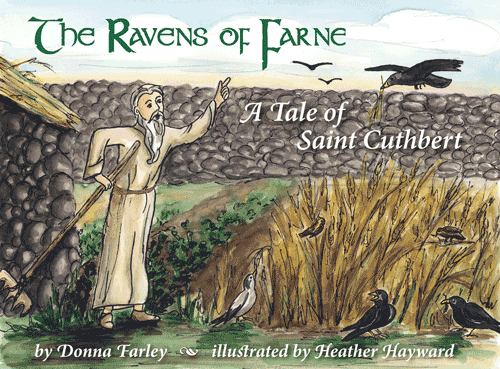
One children's book written on the life of St. Cuthburt is "The Ravens of Farne: A Tale Of St. Cuthbert" by Donna Farley. A live audio reading by Dr. Crissi Hart is also available from Ancient Faith Radio! 

 
One traditions that we found doing a bit of research was a St. Cuthbert Day soup
You can also color the cross of St. Cuthbert


Tuesday, March 17, 2015

St. Patrick, Enlightener of Ireland

Saint Patrick, the Enlightener of Ireland was born around 385, son of Calpurnius, a Roman decurion (an official responsible for collecting taxes). He lived in the village of Bannavem Taberniae, which may have been located at the mouth of the Severn River in Wales. The district was raided by pirates
when Patrick was 16, and he was one of those taken captive. He was brought to Ireland and sold as a slave, and was put to work as a herder of swine on a mountain identified with Slemish in Co. Antrim. During his period of slavery, Patrick acquired a proficiency in the Irish language, which was very useful to him in his later mission.
He prayed during his solitude on the mountain, and lived this way for six years. He had two visions. The first told him he would return to his home. The second told him his ship was ready. Setting off on foot, Patrick walked 200 miles to the coast. There he succeeded
in boarding a ship, and returned to his parents in Britaina.
Some time later, he went to Gaul and studied for the priesthood at Auxerre under St. Germanus (July 31). Eventually, he was consecrated as a bishop, and was entrusted with the mission to Ireland, succeeding St. Palladius, (July 7) who did not achieve much success in Ireland. After about a year he went to Scotland, where he died in 432.
Patrick had a dream in which an angel came to him bearing many letters. Selecting one inscribed “The Voice of the Irish,” he heard the Irish entreating him to come back to them.
Although St Patrick achieved remarkable results in spreading the Gospel, he was not the first or only missionary in Ireland. He arrived around 432 (this date is disputed), about a year after St. Palladius began his mission to Ireland. There were also other missionaries who were active on the southeast coast, but it was St. Patrick who had the greatest influence and success in preaching the Gospel of Christ. Therefore, he is known as “The Enlightener of Ireland.”
His autobiographical Confession tells of the many trials and disappointments he endured. Patrick had once confided to a friend that he was troubled by a certain sin he had committed before he was 15 years old. The friend assured him of God’s mercy, and even supported Patrick’s nomination as bishop. Later, he turned against him and revealed what Patrick had told him in an attempt to prevent his consecration. Many years later, Patrick still grieved for his dear friend who had publicly shamed him.
St. Patrick founded many churches and monasteries across Ireland, but the conversion of the Irish people was no easy task. There was much hostility, and he was assaulted several times. He faced danger, and insults, and he was reproached for being a foreigner and a former slave. There was also a very real possibility that the pagans would try to kill him. Despite many obstacles, he remained faithful to his calling, and he baptized many people into Christ.
The saint’s Epistle to Coroticus is also an authentic work. In it he denounces the attack of Coroticus’ men on one of his congregations. The Breastplate (Lorica) is also attributed to St Patrick. In his writings, we can see St Patrick’s awareness that he had been called by God, as well as his determination and modesty in undertaking his missionary work. He refers to himself as “a sinner,” “the most ignorant and of least account,” and as someone who was “despised by many.” He ascribes his success to God, rather than to his own talents: “I owe it to God’s grace that through me so many people should be born again to Him.”
By the time he established his episcopal See in Armargh in 444, St. Patrick had other bishops to assist him, many native priests and deacons, and he encouraged the growth of monasticism.
St. Patrick is often depicted holding a shamrock, or with snakes fleeing from him. He used the
shamrock to illustrate the doctrine of the Holy Trinity. Its three leaves growing out of a single stem helped him to explain the concept of one God in three Persons. Many people now regard the story of St. Patrick driving all the snakes out of Ireland as having no historical basis.
St. Patrick died on March 17, 461 (some say 492).

Books on the life of St. Patrick: 

"The Life of St. Patrick: Enlightener of the Irish" by Zachary Lynch


"Patrick: Patron Saint of Ireland" by Tomie DePaola


"The Story of Saint Patrick's Day
" (Board book) by
Patricia A. Pingry
Since St. Patrick's Day is famous for both religious and secular reasons, many of the crafts that honor the saint are combined with non-religious themes (pot of gold, rainbows, leprechauns, ect.) I'm solely sticking to religious based crafts in this blog...

paper plate shamrock
Trinity shamrock threading craft fir young kids
Bell pepper shamrock stamp
Shamrock sun catcher on a painted paper plate!

Coloring page

Last, if St. Patrick's Day is not during Lent (rare), make a feast of Irish food: Corned Beef Cabbage, boiled cabbage and bacon, boiled potatoes, colcannon, lamb stew, black pudding, cottage pie, Irish soda bread, and Guinness or cider.

A short Veggie Tales video on Saint Patrick


Troparion — Tone 3
Holy Bishop Patrick, / Faithful shepherd of Christ’s royal flock, / You filled Ireland with the radiance of the Gospel: / The mighty strength of the Trinity! / Now that you stand before the Savior, / Pray that He may preserve us in faith and love!

Thursday, March 12, 2015

St.Gregory the Great, Pope of Rome

Our father among the saints St. Gregory I, also known as Gregory the Great, was the Pope of Rome from September 3, 590, until his death on March 12, 604. He is noted for his writings.
St. Gregory's family had large land holdings in Italy, which St. Gregory sold to help the poor following his father's death. After turning his home into a monastery named for St. Andrew, Pope Pelagius II appointed him as an ambassador to Constantinople; however, Gregory disliked the worldly atmosphere of the court and never learned Greek.
After his consecration as Bishop of Rome on September 3, 590, he negotiated a peace with the Lombards, who besieged Rome, and he dispatched St. Augustine of Canterbury to evangelize Britain.
He is known in the East as Gregory the Dialogist for his four-volume Dialogues, in which he wrote of the lives and miracles of the saints of Italy and of the afterlife. It is the primary source of the lives Moralia on Job, a commentary on the Book of Job; his Homilies on Ezekiel; the Pastoral Rule, which served as the prime manual for priests in the West for many years; and a great number of other sermons.
of St. Benedict of Nursia and his sister Scholastica.
He added the commemoration of the Apostle Andrew to the embolism on the Lord's Prayer in the ancient Roman Mass; as a result, the Roman Mass is often called the Mass of St. Gregory, especially among a number of Orthodox. He was a patron of ancient Western chant, often called "Gregorian chant" for his patronage.
The Orthodox church commemorates St. Gregory on 12 March, which is during Great Lent, the only time when the Divine Liturgy of the Presanctified Gifts, which names Saint Gregory as its author, is used.


He is also the patron saint of students, teachers, scholars, and musicians/singers

On a lighter note, there is a story about St. Gregory and his craving for cherries. Although it is mostly in Catholic texts and sources, he IS a major per-schism saint so I included it here :)

On April 25 on year (St. Mark's feast day)  the Holy Father Pope Gregory the Great, frugal by nature, was suddenly overwhelmed by an incomprehensible desire for...cherries. History recounts that servants and gardeners were at a loss. The spring weather was still fresh and raw, and the cherry trees, which grew in numbers along the hills of Trastevere, from the Janiculum to the Colle del Gelsomino, were only just in blossom.
Fortunately, one gardener who was wandering in gardens in despair, was visited by St. Mark in a cloud of fire! The saint asked him why he was in such a state. As soon as he heard the answer, he uttered a special blessing on a tree, and in a flash it was covered in fragrant, succulent red cherries. As the story handed down through the centuries in Roman dialect recounts, the Pope "se ne fece subito una bella panzata" ("wasted no time in wolfing down a bellyful"). Since then, on St. Mark's feast day, the Pope usually enjoys a nice bowlful of cherries, out of not so much greed as devotion to the saint. Like him, you should enjoy cherries on his feast day!


Wednesday, March 4, 2015

St. Gerasimos of the Jordan


St. Gerasimos lived in the 5th century and was the abbot of a community of 70 monks who all lived in the desert east of Jericho, near the Jordan River. Their life was strict, they slept on reed mats, had cells without doors and observed silence. Their diet consisted mainly of water, dates, and bread. It is said, that St. Gerasimos in ongoing repentance for having been influenced by the teachings of a heretic in his youth, lived on even less than the norm.
One day while he was walking along the Jordan, Gerasimos came upon a lion roaring in agony because of a large splinter imbedded in one paw. Overcome by compassion for the beast, Gerasimos removed the splinter and cleaned the wound, bounding it up, expecting the lion to return to its cave. Instead the creature meekly followed him back to his monastery and became his devoted pet. The whole community was amazed at the animal's conversion to a peaceful nature, life and devotion to the abbot; living on bread and vegetables.
The lion was given the special task of guarding the communities donkey, which grazed along the Jordan. One day, it happened that, while the lion was napping, the donkey strayed and was stolen by a
passing trader. After searching, without success, the lion returned to the monastery, it head hanging low. The brothers concluded that the lion had been overcome and had eaten the donkey and as punishment, gave the lion the job of the donkey; to carry water each from the river to the monastery in a saddle pack with four earthen jars.
Months later, it happened that the trader was passing through the Jordan with the stolen donkey and three camels. The lion recognized the donkey and roared so loudly that the trader ran away. Taking its rope in his jaws, the lion led the donkey back to the monastery with the camels following behind. The monks realised that they had misjudged the lion; this is how the lion earned his name "Jordanes" from the Elder Gerasimos.
For a further five years, the lion "Jordanes" was part of the monastic community. When the elder fell asleep in the Lord and was buried, Jordanes lay down on the grave, roaring in his grief and beating its head against the ground. Finally Jordanes rolled over and died on the last resting place of Gerasimos.
The icon of St. Gerasimos focuses on an event of physical contact between the monk and the lion.
The abbot Gerasimos and this story are real as many texts refer to him and soon after his death he was recognised as a saint. The monastery he founded lasted for centuries and is today a place of spiritual pilgrimage in the desert.
 Saint Gerasimos cave
Book about St. Gerasimos and the Lion:

Troparion - Tone 1
O dweller of the desert and angel in the body,
You appeared to us a wonderworker.
O God-bearing Father Gerasimus
By fasting, vigil and prayer, you received heavenly gifts;
Healing the sick and the souls of those drawn to you by faith:
Glory to Him who gave you strength!
Glory to Him who gave you a crown!
Glory to Him who through you gives healing to all!